Wildlife

11/17/19 update: Done @ 5 pm yesterday! What a season 2019 has been. Looking forward to a new year and learning from the lessons of this one.

Partners,

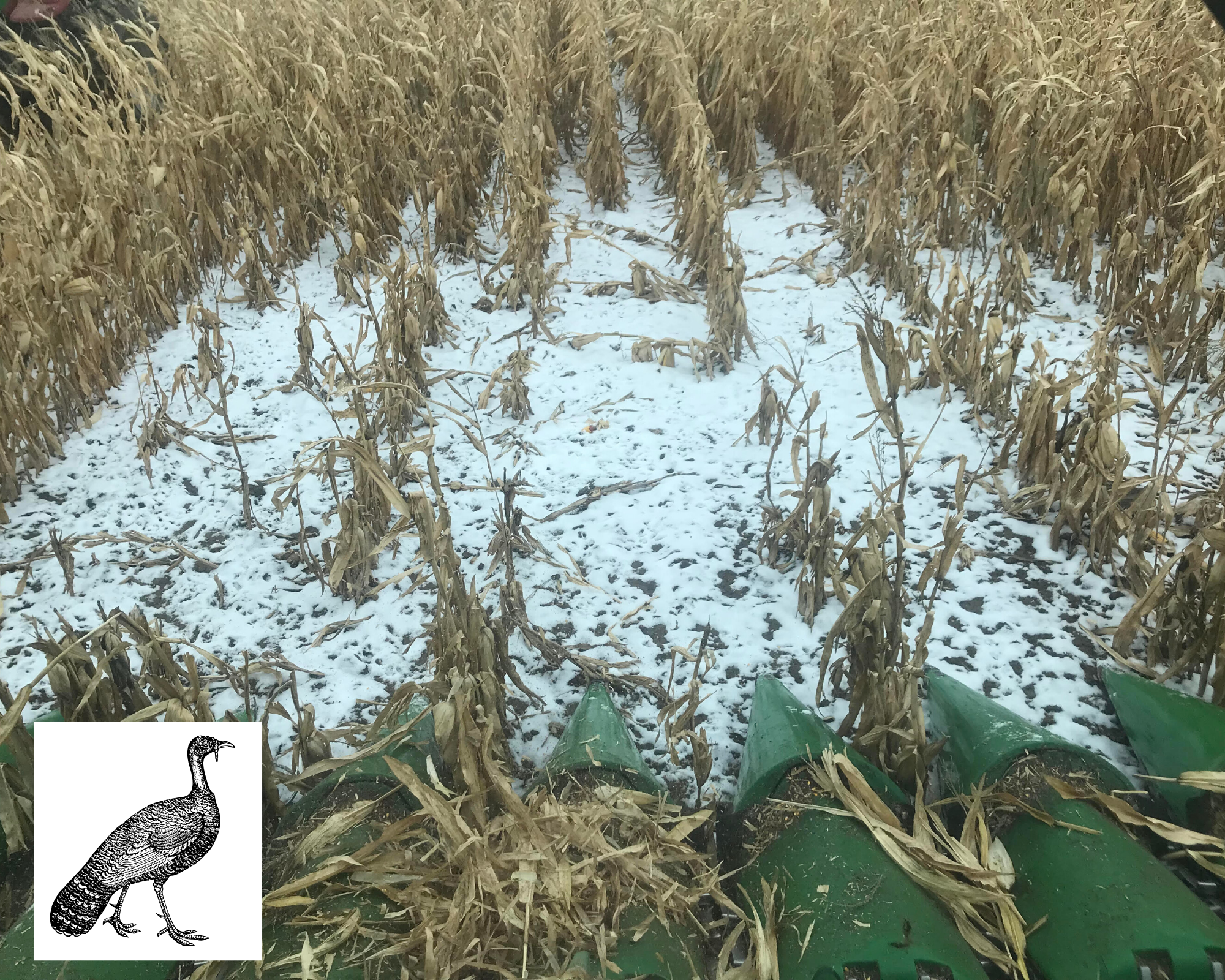
Each year at harvest time we get to appreciate—and be frustrated by—the amount of wild critters that are all around us. Some of our fields have up to 10% damage from turkeys, deer, or raccoons. The loss is more substantial in Fulton County, but almost all of our fields are close enough to some trees or stream or railroad that there are some signs of wildlife. While harvesting this past week I got some good pictures of the animal damage—with snow as a background—so I thought I would share. The financial loss is not talked about much and hard to quantify but on the yield maps the spots really stick out.

As of this morning (Friday), harvest is about two days from over. We have been picking corn on snow-covered ground this week. Thankfully there was little on the plants themselves. Snow and combine sieves don't mix well in freezing weather. The yields of the June planted corn are very average. This will be our lowest average corn yield since 2012. We finished beans this past Friday when we harvested the third planting on the bottom ground at my house (planted July 13th). They yielded a respectable 46bpa which seems incredible with that late of a planting date. We give thanks and praise for some growing anomalies. Marcus started NH3 application this week with our new-to-us tractor. We appreciate a big front wheel assist tracked tractor in the hard pull heave tillage. Using this tractor should allow us to plant directly into the NH3 strips next spring and eliminate some tillage, labor, fuel and time.


Commodity prices are drifting sideways in a typical, slow, drawn-out harvest scenario. We are not watching TV coverage of the going-ons in DC. Congress has had the USMCA on the agenda since last winter and now it looks like they don't have time to pass a trade agreement that will help our commerce.


School snow days in November don't happen too often. The extreme cold this early puts a fast spin on chores for the horses and cows. This past Sunday we enjoyed a violin recital.


Fall prices:

Corn 3.71

Soybeans 9.12


Keep in touch,

Steve

Solar Minimum

Partners,

We are keeping busy with plenty of summer projects and are now deciding which ones aren't going to make the cut this summer. Having spent the better part of the past two weeks repairing tile issues--which in large part were caused buy the rains this spring--we feel that a lot of effort is going into fixing and healing things caused by the weather the past 12 months (3rd wettest in IL on record). We are also down to just a few thousand bushels of corn to deliver, that being made possible by more normal river levels. Usually by July 1 we have the bins empty. but we’ve still been getting the equipment cleaned up and checked over from this planting season (lots of power washing for Josh, Aaron and Daniel). We have a few upgrade projects at the tower bin site to complete, and are holding out hope for some time on the lake. Yikes! School starts in 2 weeks!

Solar Minimum—google it. Apparently that is part of the reason for the cooler weather affecting the growing season. Crop conditions are struggling. we received less than 1" of rain in July, and there is very little in the next two-week forecast. The late corn is now tasseling and thankfully the cooler weather is providing some relief. The late beans are certainly short. The weather into mid-September will determine their fate. Thank goodness we were able to plant early for a few days with our two planters. The early planted fields look decent and will yield well although not above trendline. We are spraying insecticide with all the fungicide we are applying to help the plants fight the added stress of the Japanese beetle invasion. One benefit of the dryness is we are keeping up much better with the yard mowing. ;)

Nationally we are wondering where the trade battle will end. The demand side of the equation is being hammered each week with ethanol plant closings and export reductions. The livestock sector is looking at shrinking margins and now the feed supply is being curtailed. Hay supplies are tight and pastures around there are already being supplemented. No one ever said this job is boring!

Family is busy and preparing for the new school year. Found time for a Cubs-Cards game (courtesy of Compeer) and hope for a few times at the lake yet this summer. Ali still has another month at bringfido.com. Marcus and family had a great and relaxing time in upstate NY. Hoping for a day at the state fair.

Keep in touch—all questions and comments welcome.

Fall prices:

Corn 3.82

Soybeans 8.18


Steve

Showtime

Partners,

We officially quit planting on June 14. Then the rains came again and covered a lot of our replant work with water again! Now this past weekend we received another 3+ inches of rain. The equipment getting the most use these days are the sump pumps and the job we are getting good at is putting up the “Road Closed” signs. We still have about 400 acres of corn to sidedress with NH3. Over half of the beans are needing sprayed with a second pass--the weeds are growing quite well. The nearby markets have reacted the most to the crop problems which is preventing many crop pricing opportunities for 2020 and beyond. The Illinois river has been closed for over 6 weeks now. This is going to back up old crop delivery into new crop harvest and will definitely cause some long lines at the river terminals. Marketing this crop and the next several years’ will have important implications on future profitability. We attended three marketing meetings this past week.

There is great concern in the livestock industry about adequate supplies of feed for the next year. There are estimates of between 7 and 10 million acres that will be taken for corn Prevent Plant. Hay harvest has been quite delayed and we have lost at least one cutting of hay—nationwide. Areas that were not able to plant at all will have trouble sourcing nearby corn for grain and corn for silage, and feed costs will be substantially higher. We must sustain the livestock industry through this time, or in the future we will have even less demand for our crops. The harvest rules for Prevent Plant acres have been eased as far as haying or grazing. Planting a crop that has a chance to be feed-worthy will be challenging with the continuing rains. There are reports that half of China's hog herd has been wiped out with Asian Swine Flu. And projections that next year’s corn-planted acres could be over 100 million add to concern that we will immediately overproduce and get into a supply glut again.

We will be watching with much anticipation the talks this week between President Trump and the Chinese Premier. We need to find level playing field rules and keep both countries on a path of economic stability.

Show season has begun. Dog obedience was last week and coming up are bucket calf and food items. Alison is learning a lot about doggie vacations for her internship at bringfido.com. And Grandpa is reminiscing and telling stories about the other years that were weather stressors like this one--74, 83, 88 and 93 are the ones that really stand out.


Fall Prices:

Corn 4.43

Soybeans 8.93

Questions and comments welcome!

Steve

What a Planting Season

Partners,

Pulled out of the field with the bean planter for the last time Tuesday night. We are leaving some small wet areas of corn and bean acres which we might plant cover crops into when they dry up, but for now we are calling planting complete. The local weather station says we are at 179% of normal rainfall for the year. Our area is at 99% planting completion after lots of activity this past week. We replanted approximately 130 acres of corn and 85 acres of beans. Planting a field a second time is not very exciting! We are struggling to get hay baled this week with equipment challenges and weather issues. The forecast is for rain for most of the rest of this week. We do count ourselves blessed in that we are able to get most everything in the ground; several farmers across the USA we know were not so fortunate. The bean planter was pulled out 11 times (not that I was counting). Most of the bean fields were entered at least twice, planting dry areas first and then going back for wet spots. Tiling paid huge dividends this year--both in field access and the way the crop was able to emerge in all the moisture. We have identified several spots that need more in the near future if these weather anomalies are the norm. It will take years to heal the erosion and sediment from the extreme rain.

USDA is hard at work on the next round of Market Facilitation Payments to prop up falling commodity prices. Tying all of the rules into Prevent Plant guidelines and trying not to distort the market are proving formidable challenges. Here in Illinois we have just seen the most anti-business legislation in decades enact lots of new taxes without curbing anything on the cost side.

And now we have legalized pot production and consumption, so all of our problems will seem much less severe.

Family doing well--Ali is going to South Carolina to work at bringfido.com for the summer. 4-H show season is upon us. Now with planting complete a more normal lifestyle will emerge. Looking forward to a summer of fun times with family and friends.

Fall Prices:

Corn 4.28

Soybeans 8.60

Keep in touch,

Steve

Planting Progress

Partners,

The last planting we did was Sunday, April 28th in the evening—we got rained out around 11:30. We are 40% done with corn and 35% complete with soybeans. Considering that statewide, Illinois is only 11% done with corn planting and 3% done with bean planting, we feel fortunate about our situation. According to the NWS in Peoria we are at 149% of normal rainfall for the year. A year like this reinforces the value of drainage in the fields. The timeliness of being able to get field work completed is huge, and the crop that is emerging can't stand water for too many hours. We are keeping busy nonetheless. With no full-time employees, Marcus and I are filling in as truck drivers & mechanics, catching up on office work, finishing up construction projects, attending end of school year activities, and preparing for the next surge of field work. Balance of work and life!

On the national front, the Chinese trade negotiations are heating up. Studies of past trade talks have indicated we gave up too much too easily. That certainly does not seem to be the case this time! This tariff war is almost a year old now and the tweets this past week were not warm and fuzzy. Here in Illinois the current proposals in Springfield are for doubling the motor fuel tax (we have to do something with the roads; we are shaking our trucks apart hauling grain). The minimum wage will be $15 in a few short years (so much for entry-level part-time work). And the progressive income tax proposal looks like it will be on the ballot Fall 2020 (how many higher income taxpayers that have the ability to relocate will stick around to see how that plays out?).

Getting some extra family time with the delays. Phyllis and I got to see Chicago in concert. Caught the final lecture at Monmouth College of a dear family friend. Violin recital one Sunday. Track meets and hip-hop performances in St. Louis. Life is good. We are truly a blessed people! Relish yours!


Fall bids:

Corn-3.50

Soybeans-8.05

Steve